

Slave Deeds
Legal Records That Document the Sale, Transfer, and Inheritance of Enslaved People
Slave deeds, also known as slave sale documents or bills of sale for enslaved individuals, were legal contracts used during the era of American slavery to transfer ownership of enslaved people from one person or entity to another. These documents were an integral part of the slave trade and the institution of slavery itself. They recorded the sale, purchase, and transfer of enslaved individuals as if they were mere property, stripping them of their humanity and agency.
Today, they are among the most crucial records for identifying enslaved ancestors before 1870.
What Are Slave Deeds?
Slave deeds are legal court records that document the sale, transfer, inheritance, or mortgage of enslaved individuals. Created and recorded in county deed books, probate courts, and chancery records, these documents treated human beings as property under law. They were written to protect ownership rights, not family identity – yet today they serve as some of the most critical sources for reconstructing enslaved family histories before 1870.
Transaction details
- ➡️ Names of buyer and seller
- ➡️ Date and location of the transaction
- ➡️ Terms of sale and monetary value
Details about the enslaved
- ➡️ Name (often first name only)
- ➡️ Age and gender
- ➡️ Physical descriptions
- ➡️ Skills or occupations
Legal and social context
- ➡️ Economic ranking or valuation
- ➡️ Transfer through inheritance or debt
- ➡️ Separation from previous enslaver or family members
Why These Details Matter Today
Although these details were recorded to enforce ownership, they now provide evidence of family structure, movement, separation, and survival. A single slave deed may be the only surviving record thet links an enslaved person to a specific place, enslaver, or family group.
For many descendants, slave deeds represent the first written appearance of an ancestor’s name.
Research Tip: Enslaved individuals were rarely indexed by name. Always search deed records using the enslaver’s name and county.

Slave deeds were used for various purposes, including
Enslaved individuals were frequently bought and sold through public auctions, private sales, or direct trades between
When slaveholders passed away, their enslaved individuals could be included in their estates and distributed among heirs according to wills and inheritance laws. Slave deeds were used to transfer ownership from the deceased to their heirs.
Enslaved people were often used as collateral for loans. Slaveholders could use their human property as security for borrowing money, and in case of default, the enslaved individuals could be seized and sold to repay the debt.
In some areas, enslaved individuals were assessed for property tax purposes. Slave deeds were used to determine the value of the enslaved people owned by a particular individual, which affected the tax liability.
In certain cases, slaveholders could insure their enslaved individuals against loss due to death, illness, or injury. Slave deeds might be used to establish the value of the enslaved person for insurance claims.
Deeds Located on Ancestry.com
- Deeds of Gift, Deeds of Sale, Mortgages, Born Free and Freed from Laurens & Newberry Counties, SC: 1785-1827
- Louisiana, U.S., Records of Enslaved People, 1719-1820
- U.S., Definitive List of Slaves and Property, 1827-1828
- Washington D.C., Pension Correspondence and Case Files of Formerly Enslaved People, 1892-1922
Slave Deeds
No Land--Only Slaves
“No Land — Only Slaves” is a comprehensive 19-volume series compiled by Edith G. Heflin Smith and Vivian Lehman between 2004 and 2015. This work meticulously abstracts slave conveyances from deed books across various counties in Louisiana, Texas, and Arkansas, providing invaluable insights into the transactions involving enslaved individuals in these regions.
- ➡️ Bill of Sales
- ➡️ Mortgage
- ➡️ Deed of Gift
- ➡️ Partition of Property
- ➡️ Auction Records
- ➡️ Estate Appraisals
- ➡️ Emancipations
- ➡️ Manumissions
| Vol | Description | Link | Vol | Description | Link | |
| 1 | Bossier Parish, Louisiana | Open | 11 | Upshur & Ellis Counties, Texas | Open | |
| 2 | Claiborne Parish, Louisiana | Open | 12 | San Augustine County, Texas | Open | |
| 3 | Caddo Parish, Louisiana | Open | 13 | Rusk County, Texas | Open | |
| 4 | Harrison, Hunt & Kaufman Counties, Texas | Open | 14 | Travis County, Texas | Open | |
| 5 | DeSoto Parish, Louisiana | Open | 15 | Cass County, Texas | Open | |
| 6 | Lafayette County, Arkansas | Open | 16 | Navarro County, Texas | Open | |
| 7 | Panola & Grayson Counties, Texas | Open | 17 | Bastrop County, Texas | Open | |
| 8 | Bienville Parish, Louisiana | Open | 18 | Hempstead County, Arkansas | Open | |
| 9 | Smith & McLennan Counties, Texas | Open | 19 | Part A: Marion County, Texas | Open | |
| 10 | Fannin County, Texas | Open | 19 | Part B: Bell County, Texas | Open |
Below is a sample entry illustrating what each volume contains.
"No Land -- Only Slaves" Vol 2 Claiborne Parish LA
Cla Book A Page 593 10 Jun 1852/11 Dec 1852 Brantly, Larkin to his daughter, Miller, Cynthia Eliza Brantly wife of Milton W. Miller. Donation. Eliza, female, 18 black and her child Lewis, male, 2 months, copper. Witnesses: Miller, Simon B. and Miller, Morris. Notary Public: Dyer, Henry. Deputy Recorder: Markoe, M.M.H.
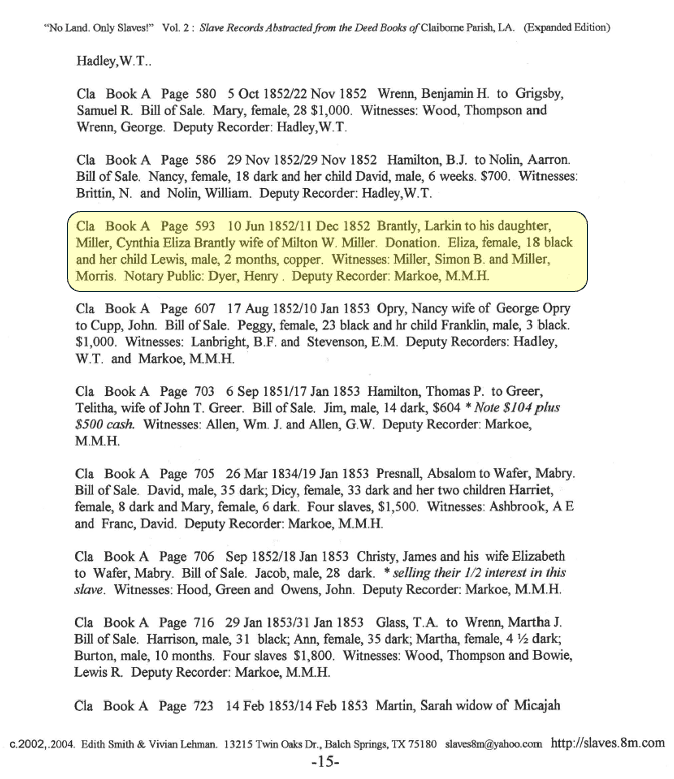
How to read the citation
“Cla Book A Page 593”
- ➡️ Claiborne Parish, Louisiana
- ➡️ Book A = the first volume of deed/conveyance records
- ➡️ Page 593 = exact page where the entry appears
- ➡️ Dates: 10 June 1852 (This is the day the legal act took place)
- ➡️ Recorded 11 December 1852
The entry describes Larkin Brantly donating enslaved people to his daughter, Cynthia Eliza Brantly Miller, which is why it appears in land/deed records, not probate.
Where you would find this record
Primary Repository
- ➡️ Claiborne Parish Clerk of Court - Land & Conveyance Records (Notarial Acts)
- ➡️ Conveyance Book A, page 593,
- ➡️ Donation dated 10 June 1852
- ➡️ Recorded 11 December 1852
- ➡️ Homer, Louisiana (parish seat)